
NFHS Volleyball Rules 2023 PDF Download: A Comprehensive Guide
Access the latest 2023-2024 NFHS Volleyball Official Rule Book in paperback format via Amazon, alongside the Case Book and Officials Manual for comprehensive guidance.
The 2023 NFHS Volleyball Rules represent the governing standards for high school volleyball across the nation, ensuring fair play and consistent officiating. These rules, meticulously crafted by the National Federation of State High School Associations (NFHS), are essential for coaches, players, and officials alike. Understanding these regulations is paramount for a successful and enjoyable season.
Key areas covered include player conduct, libero restrictions, blocking regulations, serving procedures, rotation guidelines, and detailed interpretations of specific rules like back row attacks and net faults. The NFHS provides extensive resources, including the official rulebook, case books, and presentations, to facilitate comprehension.
Staying current with these rules is crucial, as modifications occur regularly. The 2023 changes, detailed in resources from organizations like the Texas Association of Sports Officials and state associations like Nevada’s NIAA and Texas’ UIL, impact gameplay and strategy. Accessing the official PDF documents ensures accurate interpretation and application of the rules.
Importance of the Official NFHS Rulebook
The official NFHS Volleyball Rulebook is the definitive source for all rules governing high school volleyball competition. Utilizing this resource ensures consistency and fairness across all participating states, preventing discrepancies in interpretation and application. Relying on unofficial sources can lead to misunderstandings and potentially disadvantageous rulings.
For coaches, the rulebook provides a foundation for practice planning and strategic development, allowing them to teach legal techniques and anticipate opponent strategies. For players, understanding the rules fosters responsible gameplay and minimizes penalties. For officials, it’s the bedrock of accurate calls and effective game management.
The PDF format offers convenient accessibility and portability, enabling quick reference during practices, matches, and rules meetings. Resources like the NFHS Case Book complement the rulebook, providing real-world examples and clarifying ambiguous situations. Investing in the official rulebook is an investment in the integrity of the sport.
Where to Download the 2023-2024 NFHS Volleyball Rulebook (PDF)
Accessing the official 2023-2024 NFHS Volleyball Rulebook in PDF format is readily available through several avenues. The Nevada Interscholastic Activities Association (NIAA) provides links to both the 2023-2024 and previous years’ presentations (PPT & PDF) on their website, serving as a valuable resource for officials and coaches.
Additionally, the University Interscholastic League (UIL) offers NFHS Volleyball and Rules Information, alongside links to rulebooks for various sports. You can purchase the 2023-2024 NFHS Volleyball Official Rule Book in paperback format from Amazon.com. The Texas Association of Sports Officials directs users to a link (in the upper right of their page) for downloading the rulebook.
Remember to prioritize official sources to ensure you have the most accurate and up-to-date information. These resources provide comprehensive guidance for players, coaches, and officials alike, promoting fair play and a thorough understanding of the game.

Key Rule Changes for 2023
The NFHS published new rule changes for 2023, including a note regarding potential adoption of a nonsmooth ball beginning in the 2026-2027 school year.

Overview of Significant Rule Modifications
The 2023 NFHS volleyball rule changes, detailed within the official rulebook and supporting materials, represent key adjustments for players, coaches, and officials. Texas Association of Sports Officials highlights the availability of these changes for review and download. A notable modification concerns a future consideration – beginning with the 2026-2027 school year, state associations may choose to implement a rule allowing the use of a nonsmooth or textured volleyball.
This potential shift aims to explore alternative ball characteristics and their impact on gameplay. Currently, the focus remains on consistent application of existing rules, with resources like the NFHS Volleyball Case Book and Officials Manual providing clarification on interpretations. State associations, such as the Nevada Interscholastic Activities Association (NIAA) and the University Interscholastic League (UIL) in Texas, offer supplementary materials, including pre-season rules meeting packets and presentations, to ensure widespread understanding and compliance.
Rule 3.2.1 ー Player Conduct and Sanctions
While specific details regarding Rule 3.2.1 – Player Conduct and Sanctions – aren’t explicitly outlined in the provided excerpts, the overarching importance of appropriate behavior is implicitly emphasized throughout the NFHS resources. The official rulebook, case book, and officials’ manual collectively serve as guides for maintaining sportsmanship and addressing misconduct.
Understanding acceptable conduct is crucial for all participants – players, coaches, and officials – to ensure fair play and a positive competitive environment. Sanctions for violations, as detailed within the complete rulebook, likely range from warnings and penalties to disqualification, depending on the severity of the infraction. State associations, like the NIAA and UIL, reinforce these standards through pre-season meetings and educational materials. Accessing the 2023-2024 NFHS Volleyball Official Rule Book is essential for a complete understanding of conduct expectations and associated penalties.
Rule 5.2.2 ー Libero Restrictions Updates
Unfortunately, the provided text snippets do not detail specific updates to Rule 5.2.2 concerning Libero Restrictions for the 2023-2024 season. However, the NFHS consistently refines rules to enhance clarity and fairness. Therefore, a thorough review of the official 2023-2024 NFHS Volleyball Rulebook is paramount for coaches and officials.
Libero rules, known for their unique parameters regarding substitution and back-row play, often undergo adjustments. Understanding current restrictions on serving, attacking, and blocking is vital for legal play. Resources from state associations like the NIAA and UIL, alongside the NFHS Volleyball Officials Manual and Case Book, will offer detailed interpretations. Accessing the complete rulebook, available in paperback and potentially as a PDF, ensures compliance with the latest regulations governing the Libero position.
Rule 6.2.3 ー Blocking Regulations Clarifications
Regrettably, the provided information doesn’t specify clarifications within Rule 6.2.3 regarding blocking regulations for the 2023-2024 volleyball season. However, blocking rules are frequently scrutinized for fairness and safety, making it crucial to consult the official NFHS Volleyball Rulebook.
Clarifications often address aspects like reaching over the net, penetration under the net, and the legality of back-row blocking. Coaches and officials must stay informed about these nuances to ensure accurate calls and legal gameplay. Resources like the NFHS Volleyball Officials Manual and Case Book, alongside state association materials (NIAA, UIL), provide in-depth interpretations. Obtaining the complete rulebook – available in paperback and potentially as a downloadable PDF – is essential for understanding the most current blocking regulations and avoiding penalties.

Understanding Core Volleyball Rules
Master fundamental aspects like serving, rotation, blocking, and attacking by referencing the official 2023-2024 NFHS Volleyball Rulebook for detailed regulations.

Serving Rules and Regulations
Detailed serving regulations are comprehensively outlined within the 2023-2024 NFHS Volleyball Rulebook. This essential resource clarifies all aspects of the serve, from the server’s positioning to the execution of the serve itself. Understanding these rules is paramount for both players and officials.
The rulebook meticulously defines legal serving techniques, including restrictions on foot faults and the timing of the serve. It also addresses situations involving service order violations and the consequences for illegal serves. Furthermore, the document provides clarity on the interaction between the serve and the net, detailing what constitutes a let serve and how it should be handled.
Coaches and players can utilize the NFHS rulebook to ensure compliance with all serving regulations, minimizing penalties and maximizing strategic opportunities. Accessing the PDF version allows for convenient review and quick reference during practices and competitions. Proper understanding of these rules is crucial for fair play and a competitive environment.
Rotation and Player Positioning
The 2023-2024 NFHS Volleyball Rulebook provides exhaustive details regarding proper rotation and player positioning, fundamental aspects of the game. Correct rotation ensures fairness and prevents illegal player alignments, while strategic positioning maximizes team effectiveness. The rulebook clearly defines the rotation sequence, outlining how players must move after each side-out.
It specifies the consequences of rotation errors, including penalties for incorrect positioning at the service line. The document also addresses restrictions on front-row and back-row player actions, clarifying which players can participate in blocking and attacking from different zones. Understanding these positional rules is vital for avoiding violations and maintaining a legal lineup.
Coaches can leverage the NFHS rulebook to educate their teams on proper rotation procedures and strategic positioning. The downloadable PDF format facilitates easy access to these critical guidelines during training sessions and matches, promoting a thorough grasp of these essential volleyball principles.
Blocking and Net Play
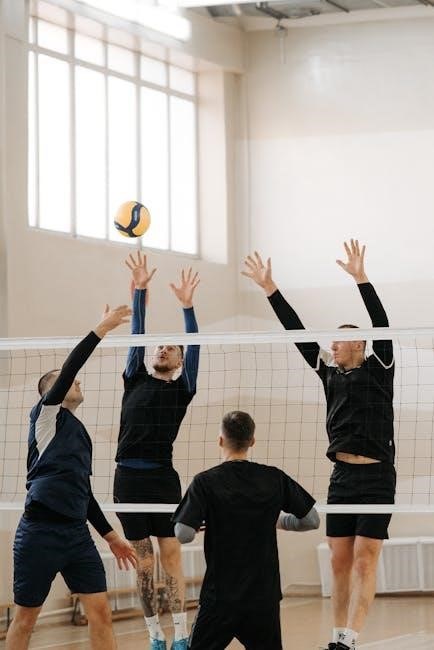
The 2023-2024 NFHS Volleyball Rulebook meticulously details regulations surrounding blocking and net play, crucial elements impacting game strategy and legality. It clarifies permissible blocking techniques, including rules regarding reaching over the net and contact with the ball during a block. The rulebook addresses restrictions on net contact, defining what constitutes a fault and the resulting penalties.
Specific guidance is provided on back-row blocking, outlining which players are permitted to participate and the limitations they face. The document also clarifies rules concerning incidental net contact, distinguishing between legal and illegal touches. Understanding these nuances is essential for players and officials alike to ensure fair play and accurate calls.
Coaches can utilize the downloadable PDF rulebook to instruct players on proper blocking form and net play etiquette, minimizing faults and maximizing blocking effectiveness. A thorough understanding of these rules is paramount for competitive success.
Attacking and Hitting Rules
The NFHS Volleyball Rulebook’s 2023-2024 edition provides detailed regulations governing attacking and hitting, fundamental skills in the sport. It clarifies legal hitting zones, specifying where a player can contact the ball above net height. The rules delineate permissible attack approaches, including restrictions on crossing the attack line illegally.
Specific attention is given to back-row attack rules, outlining limitations for players attacking from behind the ten-foot line. The document details what constitutes a legal back-row attack versus a fault, ensuring fair play. It also addresses rules regarding open-hand tips and dinks, clarifying their legality and restrictions.
Coaches can leverage the downloadable PDF to educate players on proper hitting techniques and attack strategies, minimizing errors and maximizing offensive efficiency. Understanding these rules is vital for both offensive players and defensive teams anticipating attacks.
Officials Resources and Training
Explore the NFHS Volleyball Officials Manual and Case Book, alongside state association resources like NIAA and UIL, for comprehensive training materials.
NFHS Volleyball Officials Manual
The NFHS Volleyball Officials Manual serves as a cornerstone resource for those involved in officiating high school volleyball matches. This essential document provides detailed guidance on rule interpretations, mechanics, and best practices for ensuring fair and consistent gameplay. It’s designed to equip officials with the knowledge necessary to confidently manage all aspects of a volleyball contest, from pre-match procedures to post-match reporting.
Within its pages, officials will find comprehensive explanations of each rule, accompanied by illustrative diagrams and practical examples. The manual also addresses common scenarios encountered during matches, offering clear directives on how to handle various situations. Furthermore, it emphasizes the importance of professional conduct, communication skills, and teamwork among officials. Accessing and thoroughly studying the NFHS Volleyball Officials Manual is crucial for maintaining a high level of competence and upholding the integrity of the sport.
It complements the NFHS Volleyball Case Book, providing a holistic understanding of rule applications.
NFHS Volleyball Case Book
The NFHS Volleyball Case Book is an invaluable companion to the official rulebook, offering real-world scenarios and detailed interpretations of how rules are applied in various game situations. Unlike the rulebook’s broad statements, the Case Book presents specific plays and provides the correct ruling, along with a thorough explanation of the reasoning behind it. This allows officials to develop a deeper understanding of the rules and improve their decision-making skills.
Each case is carefully crafted to address common challenges and ambiguities that arise during volleyball matches. The Case Book covers a wide range of topics, including serving, blocking, attacking, and libero play, ensuring that officials are prepared to handle any situation they may encounter. It’s an essential tool for training, review, and ongoing professional development.
Combined with the Officials Manual, it provides a complete resource for effective officiating.
State Association Resources (e.g., NIAA, UIL)
State high school athletic associations, such as the Nevada Interscholastic Activities Association (NIAA) and the University Interscholastic League (UIL) in Texas, play a crucial role in disseminating NFHS volleyball rules and providing localized support. These organizations often host pre-season rules meetings for coaches, offering presentations and packets detailing rule changes and interpretations.
The NIAA, for example, provides downloadable PowerPoint presentations (PDF format available) from previous years, covering NFHS rules. The UIL offers a comprehensive overview of rules across various sports, including volleyball, with contact information for the Director of Athletics, Ray Zepeda. These associations supplement the national NFHS resources with state-specific guidelines and interpretations.
Accessing these state-level resources ensures coaches and officials are informed about any modifications or clarifications adopted within their specific region, fostering consistent rule application.
Specific Rule Areas & Interpretations
Delve into detailed explanations of Libero rules, back row attacks, net faults, and illegal blocks, clarifying penalties and ensuring accurate game management.
Libero Rules in Detail
The Libero, a specialized defensive player, operates under unique regulations outlined in the NFHS rulebook. Key aspects include restrictions on front-row attacks – the Libero cannot complete an attack hit from anywhere if any part of the ball is higher than the top of the net when contact occurs.
Furthermore, the Libero is confined to the back row and cannot serve, except for a replacement for a back-row player. Proper Libero replacement procedures are crucial; substitutions must occur during a dead ball and are recorded similarly to regular substitutions, but with specific Libero designation.
Understanding the limitations on blocking is also vital; Liberos cannot participate in blocking actions. The rulebook provides detailed guidance on legal and illegal Libero play, including scenarios involving simultaneous contact and out-of-rotation situations. Officials must be well-versed in these nuances to ensure fair play and accurate rule enforcement.
Back Row Attack Rules Explained
Back row players, excluding the Libero, face specific restrictions when attacking the ball. A player cannot attack from anywhere if, at the moment of contact, any part of the ball is higher than the top of the net. However, a back-row player may complete an attack jump if they take off from behind the attack line (10-foot line).
This rule aims to balance offensive opportunities with defensive integrity. It prevents back-row players from freely jumping and attacking from in front of the attack line, which would create an unfair advantage. Officials must carefully observe the player’s position relative to the attack line at the moment of takeoff.
Violations result in a fault and point for the opposing team. Understanding the distinction between a legal jump and an illegal attack is crucial for players, coaches, and referees alike. The NFHS rulebook provides detailed diagrams and explanations to clarify these complex regulations.
Net Faults and Violations
Contacting the net during play is a common source of faults, but the rules are nuanced. Incidental contact that doesn’t interfere with play is generally permitted. However, any contact that affects the play – such as hindering an opponent or giving an advantage to the contacting team – is a fault.
Players cannot reach over the net to contact the ball in the opponent’s space unless a legitimate block attempt has been made after the opponent’s attack. Touching the antenna, the net cables, or the band at the top of the net is always a fault, regardless of whether it impacts play.
Officials must carefully assess whether net contact truly influences the outcome of the rally. The NFHS rulebook offers detailed guidance and case studies to aid in accurate judgment calls. Consistent application of these rules is vital for fair play.
Illegal Blocks and Their Penalties
Blocking regulations are specific, and violations can result in point penalties. A blocker cannot complete a block and then be the first to attack the blocked ball if the block occurs in the front zone. This prevents a quick, unchallenged attack immediately following a block.
Back-row blockers must adhere to strict rules; they cannot complete a block if, at the moment of contact, they are located in the front zone and have not legally entered the front zone. Reaching beyond the net is permissible, but the blocker’s feet must remain behind the attack line.
Penalties for illegal blocks typically involve awarding a point and the serve to the opposing team. Officials must carefully observe blocker positioning and timing to ensure compliance with NFHS rules. The rulebook provides case plays to clarify complex blocking scenarios.

Resources for Coaches and Players
Explore NFHS Volleyball Rules Presentations (PPT & PDF), pre-season meeting packets for girls and boys, and Return to Play guidelines when available.
NFHS Volleyball Rules Presentation (PPT & PDF)

Coaches and officials, enhance your understanding with readily available NFHS Volleyball Rules Presentations; The Nevada Interscholastic Activities Association (NIAA) provides access to presentations spanning multiple years, including 2023-2024, 2022-2023, and even earlier versions like 2021-2022 and 2019-2020.
These resources, offered in both PowerPoint (PPT) and Portable Document Format (PDF), are invaluable for pre-season meetings and rule clarification. The NIAA also offers a specific Return to Play PPT created by Ellen Townsend, addressing safety protocols.
Furthermore, the University Interscholastic League (UIL) directs users to NFHS Volleyball and Rules Information, covering a broad spectrum of sports. These presentations serve as excellent tools for consistent rule interpretation and fostering a shared understanding amongst all stakeholders in high school volleyball.
Pre-Season Rules Meeting Packets (Girls & Boys)
Prepare for the season with dedicated pre-season rules meeting packets provided by the Nevada Interscholastic Activities Association (NIAA). Recognizing the distinct needs of both girls’ and boys’ volleyball programs, the NIAA offers separate packets for each.
Specifically, you can download the 2023-2024 Volleyball Coaches Pre-Season Rules Meeting Packet tailored for Girls Volleyball, and a corresponding packet designed for Boys Volleyball. These comprehensive resources are crucial for ensuring all coaches are aligned on the latest NFHS rules and interpretations before competition begins.
These packets facilitate productive meetings, promoting clarity and consistency in rule application throughout the season. Accessing these materials is a proactive step towards a smooth and fair volleyball experience for all athletes and teams. Don’t delay – download your packet today!
Return to Play Guidelines (Where Available)
Prioritizing athlete safety, resources for “Return to Play” protocols are available, though their accessibility varies. The NIAA, in collaboration with the NFHS, previously offered a Return to Play PPT created by Ellen Townsend, specifically addressing considerations following interruptions to play.
This presentation likely outlined guidelines for safely reintegrating athletes back into volleyball activities after illness or injury, focusing on phased approaches and monitoring for symptoms. While the availability of current, updated guidelines may depend on prevailing health conditions and state-specific regulations, it’s crucial to check with your state association.
Always consult the most recent guidance from the NFHS and your state’s governing body (like the NIAA or UIL) to ensure compliance and protect the well-being of your players. Proactive safety measures are paramount for a successful and healthy season.
Looking Ahead: Future Rule Changes
Beginning in the 2026-2027 school year, state associations may consider adopting rules allowing the use of a nonsmooth or textured volleyball.
Anticipated Rule Changes for 2026-2027 (Nonsmooth Ball)
A significant potential shift looms on the horizon for NFHS volleyball, with discussions centering around the possible adoption of a nonsmooth or textured ball starting in the 2026-2027 school year. This isn’t a mandated change, but rather an option presented to state associations, allowing them the autonomy to decide whether to implement it within their respective jurisdictions;
The rationale behind exploring this alteration stems from a desire to potentially influence the game’s dynamics. A textured ball could alter ball control, impacting serving, passing, and attacking techniques. It may lead to increased difficulty in maintaining rallies, potentially emphasizing power and strategic placement over prolonged exchanges.
Currently, the NFHS is gathering data and feedback from coaches, players, and officials to assess the potential impact of such a change. State associations will likely evaluate these findings before making a decision. This forward-looking approach ensures a well-informed transition, should the nonsmooth ball be embraced.
Staying Updated with NFHS Volleyball Rules
Consistent rule updates are integral to the evolution of volleyball, demanding that coaches, players, and officials remain proactively informed. The NFHS serves as the primary source for the latest rulebooks, casebooks, and presentations, readily available for download. Regularly checking the NFHS website is crucial for accessing these resources.
Furthermore, state associations like the Nevada Interscholastic Activities Association (NIAA) and the University Interscholastic League (UIL) in Texas, provide localized resources, including pre-season meetings, rules packets, and specific interpretations relevant to their regions. Participating in these meetings and utilizing provided materials is highly recommended.
Staying current also involves monitoring announcements from sports officials associations, such as the Texas Association of Sports Officials, which often highlight key rule changes. Utilizing these combined resources ensures a comprehensive understanding and consistent application of NFHS volleyball rules throughout each season.